



[ad_1]
The prediction of future advancements in energy has been a tricky business for experts. Recent predictions for the year 2050 have shown that some experts were off-base in their predictions. One of the most notable examples is the lack of attention given to crypto mining in demand response.
Demand response refers to the ability of customers to adjust their electricity consumption in response to changes in the price of electricity or to incentives offered by utilities or other third parties. The goal of demand response programs is to reduce the need for electricity during periods of peak demand, which can help to reduce the strain on the power grid and lower overall electricity costs.
The Need to Reduce Energy Costs
A quiet revolution is currently happening in the field of demand response. Initial data shows that demand response has been a runaway success with take up in the seven figures, far surpassing the forecasted tens of thousands. This is a significant shift from a decade ago, when demand response was not as popular in the domestic format in the US.
In the UK, demand response has recently made a dramatic breakthrough into the public consciousness. The concept has even made its way into the lexicon of new words. Last month, Reuters reported that Flexers are the one million electricity consumers who signed up for the newly launched Demand Flexibility Service. This requires them to use less than their normal power consumption in pre-notified time slots.
Energy companies have not fully understood the psychology of ordinary consumers, as they are willing to sacrifice the on-demand nature of switching on appliances in order to save money on high bills. Peter King, Global Energy and Utilities Lead at Capgemini Invent, attributes the success of demand response to the overhaul of inflexible software platforms that previously hindered energy companies from getting involved in demand response offerings. Additionally, the increase in smart meters has also played a role in the success of demand response.
Crypto Mining to the Rescue
Another innovation that has been seen in the energy industry is the use of crypto mining, the process of using computer power to verify and record transactions on a blockchain, in demand response.
In 2021 Marathon Digital Holdings, a NASDAQ-listed Texan Bitcoin mining company, came up with an interesting idea. The firm located a wind farm in Texas with a generation capacity of 280 MW, but the transmission system couldn’t bring all of the output onto the system.
By being an interruptible and steady baseload, the crypto mine could pull energy from the wind farm and prevent the need for curtailment when the wind was at full tilt. This not only stabilizes the output of the wind farm, but also helps avoid congestion and problems balancing the grid during different external loads.
This innovation shows how the energy crisis has brought about a more practical and creative approach to energy. This is especially true in Texas, where the market is unregulated and entrepreneurs have an incentive to find new solutions.
The Chairman and CEO, Fred Thiel, recognizes the irony in Bitcoin, a technology that has a large carbon footprint, being used to save carbon and avoid renewable energy curtailment. However, Thiel remains optimistic about the venture and points to the entrepreneurial spirit found within Texas.
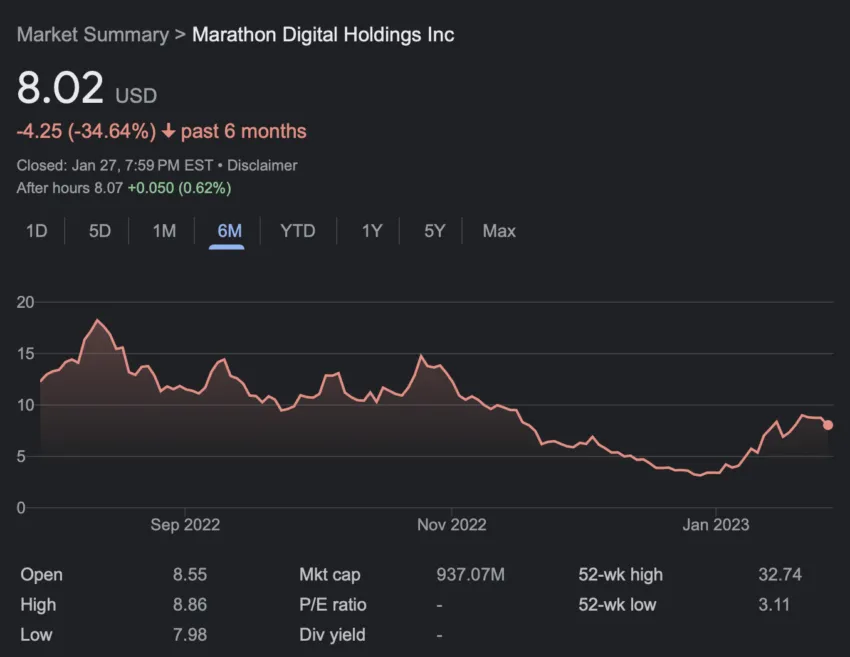
MARA experienced a decline in its share prices on Friday, January 27. The shares dropped by 7.4% to close at $8.10 after trading as low as $8.09 during mid-day trading. The shares have been evaluated by several research firms recently. Jefferies Financial Group has lowered its rating from “buy” to “hold” and lowered its price target from $12.50 to $4.00.
Unexplored Territory
Crypto mining can have several benefits for electricity grids. One benefit is that crypto mining can be used as a demand response tool, allowing energy companies to pull energy from renewable sources when the grid is at full capacity. This helps to stabilize the output of renewable energy sources and avoid congestion on the grid.
Another benefit is that crypto mining is that it can help to reduce costs for energy companies. By using surplus energy to mine cryptocurrencies, energy companies can turn otherwise wasted energy into a source of revenue.
Additionally, crypto mining also has the potential to be a more sustainable energy source than traditional fossil fuels. This is because it does not produce emissions and can be powered by renewable energy sources, which help to reduce the carbon footprint of energy production.
Despite the benefits, crypto mining is known to have high energy consumption. Still, the industry is working on becoming more sustainable through using renewable energy sources and developing more energy-efficient hardware.
Disclaimer
BeInCrypto has reached out to company or individual involved in the story to get an official statement about the recent developments, but it has yet to hear back.
[ad_2]
Source link



