



[ad_1]
The Ebba Maersk container ship, operated by A.P. Moeller-Maersk A/S, leaves Suez port and heads towards the Red Sea after passing through the Suez Canal in Suez, Egypt on Saturday, April 6, 2013.
Kristian Helgesen | Bloomberg | Getty Images
A.P. Moller-Maersk, the second-largest global ocean carrier, is advising customers to prepare for a Red Sea crisis that could stretch well into the second half of this year.
“Unfortunately, we don’t see any change in the Red Sea happening anytime soon,” Charles van der Steene, regional president for Maersk North America, tells CNBC. “We’re advising them the longer transit routes could last through Q2 and potentially Q3. Customers will need to make sure they have the longer overall transit time built into their supply chain.”
On January 5, Maersk announced that it was suspending voyages through the Red Sea and Gulf of Aden for the “foreseeable future” after the attack on the Maersk Hangzhou. After attacks on two U.S.-flagged Maersk vessels on January 24, the Maersk Detroit and Maersk Chesapeake, Maersk Line, Limited — a U.S. subsidiary of Maersk, which operates U.S.-flagged vessels independently — announced it would no longer traverse the Red Sea.
The global shipping and logistics company’s cautious view of the Red Sea safety conditions comes despite a U.S.-led multinational military operation in the region, Operation Prosperity Guardian. According to U.S. defense data, Houthi rebels have either attacked or threatened commercial vessels at least 46 times since November. Despite multiple strikes by the U.S. and allies against rebel targets, Houthis have warned that their attacks “will continue until the aggression against Gaza stops.”
The longer transits around the Cape of Good Hope are delaying the arrival of the empty vessels going back to Asia to pick up more U.S. imports. The delays are impacting the consistency of trade which can impact the supply chain. Van der Steene said he is urging U.S. companies to remain vigilant in their assessment of the Red Sea situation and be nimble in their supply chain logistics strategies.
Maersk was the largest ocean carrier for U.S. exports in 2023, based on customs data. Maersk Line, Limited’s U.S.-flagged vessels are enrolled in the Maritime Security Program and VISA (Voluntary Intermodal Sealift) with the U.S. government. It has the largest number of U.S. flagged vessels serving the country, in addition to its foreign-flagged fleet which transports ocean freight for U.S. companies.
“Our advice to our customers is specifically about building upon the uncertainty by being agile,” said van der Steene. “Customers need to have the ability to enter the North American market from different endpoints. Be it the West Coast, Gulf, or the East Coast. Our preparation of services very much depends on one-to-one work with our customers to identify what is their best alternative.”
Data from maritime advisory firm Sea-Intelligence shows that the average delay for late vessel arrivals has “deteriorated,” and as a result, vessel capacity has diminished, with impacts for U.S. East Coast-bound ocean freight from Asia going around the Horn of Cape Hope.
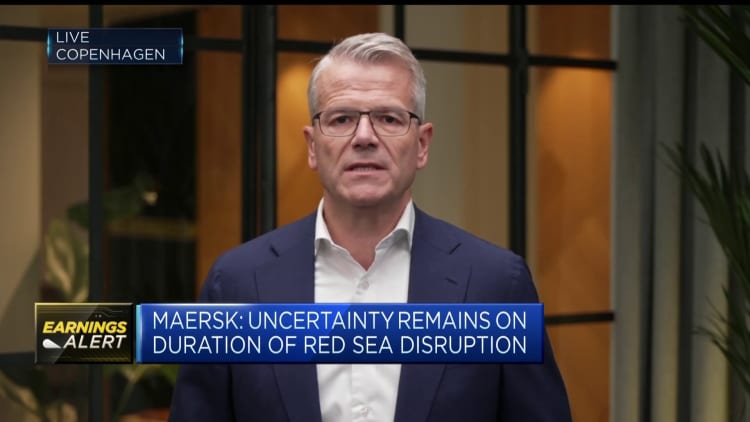
To keep the flow of trade moving, van der Steene told CNBC, Maersk has added about 6 percent of extra vessel capacity to its schedule, adding to operational costs. During its recent earnings call, Maersk executives flagged “high uncertainty” in its 2024 earnings outlook, citing the Red Sea disruptions and an oversupply of shipping vessels.
“U.S. businesses are concerned about delivery timing,” said van der Steene. “Merchant decisions are based on how reliable and how consistent their supply chain will be for the next three, six, 12, 24 months.”
In addition to delivery, van der Steen said shippers need to quantify the cost for their supply chain to the actual costs for their supply chain.
“Many of our customers factor a cost per unit cost for their supply chain into their budgeting, which basically is what they need to make their results work,” he said. “If that fundamentally shifts and changes, it could have a pretty significant effect on their overall costs.”
Ocean freight prices have jumped as a result of the longer voyage, costs not planned in shippers’ budgets, but recent data has suggested that inflation related to the Red Sea may be peaking already. Maersk officials said during its recent earnings call that the situation will not compare to the Covid supply chain inflation period due to the current overcapacity of vessels resulting from a post-Covid freight industry recession.
U.S. companies, van der Steene says, are faced with three supply chain headwinds: Red Sea diversions, East Coast port labor negotiations, and the Panama Canal drought. Shippers are looking for alternatives to cut both the time and rising cost of transit.
Ports in Mexico, the Pacific Northwest, and Los Angeles and Long Beach will be ports receiving some East Coast bound freight, van der Steene said. He described Mexico as a “significant” opportunity due to the expansion of nearshoring of products once manufactured in China. Recent trade data from the U.S. government showed that for the first time in decades, Mexico surpassed China as the nation’s largest trade partner.
For East Coast trade originating from the Oceania (Australia and New Zealand) region and going through the Panama Canal, Maersk recently announced it was expediting freight flow by moving those containers via rail instead of waiting to traverse the canal, which has drought restrictions reducing the number of vessels allowed for daily transit.
“The concern of Panama hasn’t gone away,” said van der Steene. “It has stabilized in the sense that people know what to expect, but we don’t know if this might potentially be recurring on an ongoing basis in the future. As a result, we’re actively looking to potentially have a better West Coast approach that would somehow mitigate the risk of the throughput being reduced on an ongoing basis.”
[ad_2]
Source link



