
The total crypto market cap continues to crumble as the dollar index hits a 20 year high



[ad_1]
From a bearish perspective, there’s a fair probability that the crypto market entered a descending channel (or wedge) on Aug. 15 after it failed to break above the $1.2 trillion total market capitalization resistance. Even if the pattern isn’t yet clearly distinguishable, the last couple of weeks have not been positive.
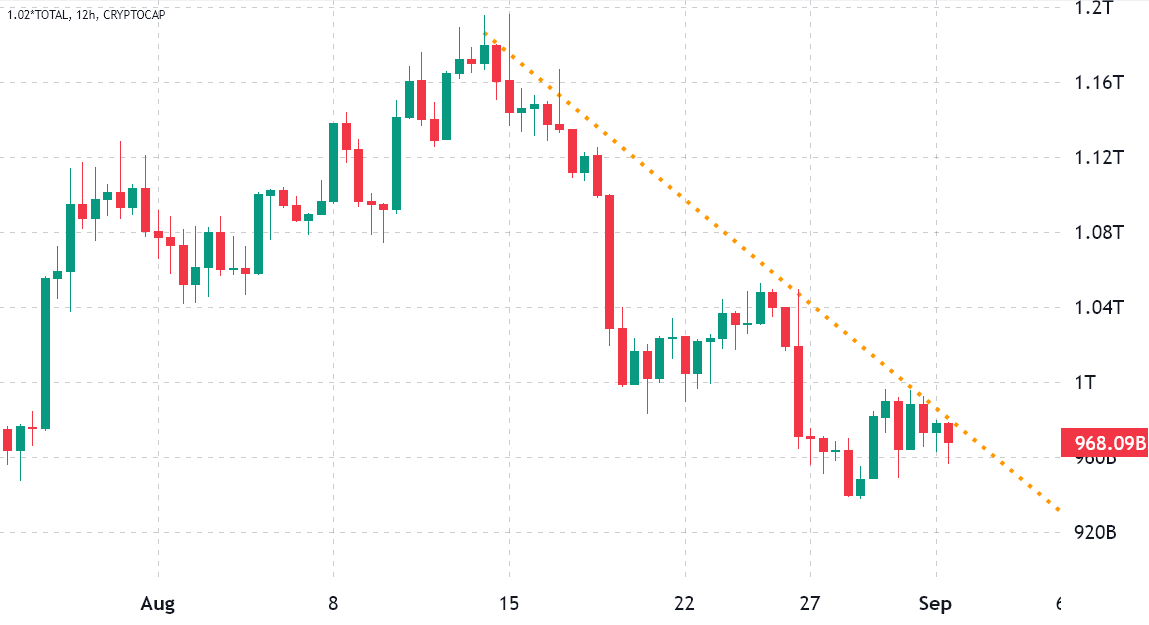
For example, the $940 billion total market cap seen on Aug. 29 was the lowest in 43 days. The worsening conditions have been accompanied by a steep correction in traditional markets, and the tech-heavy Nasdaq Composite Index has declined by 12% since Aug. 15 and even WTI oil prices plummeted 11% from Aug. 29 to Sept. 1.
Investors sought shelter in the dollar and U.S. Treasuries after Federal Reserve Chair Jerome Powell reiterated the bank’s commitment to contain inflation by tightening the economy. As a result, investors took profits on riskier assets, causing the U.S. Dollar Index (DXY) to reach its highest level in over two decades at 109.6 on Sept 1. The index measures the dollar’s strength against a basket of top foreign currencies.
More importantly, the regulatory newsflow remains largely unfavorable, especially after U.S. federal prosecutors requested internal records from Binance crypto exchange to look deeper into possible money laundering and recruitment of U.S. customers. Since late 2020, authorities have been investigating whether Binance violated the Bank Secrecy Act, according to Reuters.
Crypto investor sentiment re-enters the bearish zone
The risk-off attitude caused by Federal Reserve tightening led investors to expect a broader market correction and is negatively impacting growth stocks, commodities and cryptocurrencies.

The data-driven sentiment Fear and Greed Index peaked on Aug. 14 as the indicator hit a neutral 47/100 reading, which did not sound very promising either. On Sept. 1 the metric hit 20/100, the lowest reading in 46, and typically deemed a bearish level.
Below are the winners and losers from the past seven days as the total crypto capitalization declined 6.9% to $970 billion. While Bitcoin (BTC) and Ether (ETH) presented a 7% to 8% decline, a handful of mid-capitalization altcoins dropped 13% or more in the period.

eCash (XEC) jumped 16.5% after lead developer Amaury Séchet announced the Avalanche post-consensus launch on eCash Mainnet, expected for Sept. 14. The update aims to bring 1-block finality and increase protection against 51% attacks.
NEXO gained 3.4% after committing an additional $50 million to its buyback program, giving the company more discretionary ability to repurchase its native token on the open market.
Helium (HNT) lost 29.3% after core developers proposed ditching its own blockchain in favor of Solana’s. If passed, Helium-based HNT, IOT and MOBILE tokens and Data Credits (DCs) would also be transferred to the Solana blockchain.
Avalanche (AVAX) dropped 18.2% after CryptoLeaks released an unverified video showing Kyle Roche, the partner at Roche Freedman, saying that he could sue Solana, one of Avalanche’s top rivals, on behalf of Ava Labs.
Most tokens performed negatively, but retail demand in China slightly improved
The OKX Tether (USDT) premium is a good gauge of China-based retail crypto trader demand. It measures the difference between China-based peer-to-peer (P2P) trades and the United States dollar.
Excessive buying demand tends to pressure the indicator above fair value at 100%, and during bearish markets, Tether’s market offer is flooded and causes a 4% or higher discount.

On Oct. 30, the Tether price in Asia-based peer-to-peer markets reached a 0.4% premium, its highest level since mid-June. Curiously, the move happened while the crypto total market cap dropped 18.5% since Aug. 15. Data shows there hasn’t been panic selling from retail traders, as the index remains relatively neutral.
Traders must also analyze futures markets to exclude externalities specific to the Tether instrument. Perpetual contracts, also known as inverse swaps, have an embedded rate usually charged every eight hours. Exchanges use this fee to avoid exchange risk imbalances.
A positive funding rate indicates that longs (buyers) demand more leverage. However, the opposite situation occurs when shorts (sellers) require additional leverage, causing the funding rate to turn negative.

Perpetual contracts reflected a moderately bearish sentiment as the accumulated funding rate was negative in every instance. The current fees resulted from an unstable situation with higher demand from leverage shorts, those betting on the price decrease. Still, even the 0.70% negative weekly funding rate for Ethereum Classic (ETC) was not enough to discourage short sellers.
Negative regulatory and macroeconomic pin down sentiment
The negative 6.9% weekly performance should be investors’ least worry right now because regulators have been targeting major crypto exchanges. For example, they claim that altcoins should have been registered as securities and that the sector has been used to facilitate money laundering.
Moreover, the weak sentiment metrics and imbalanced leverage data signal investors are worried about the impacts of a global recession. Even though Tether data in Asian markets shows no signs of retail panic selling, there is no evidence of traders having a bullish appetite because the total crypto market cap approached its lowest level in 45 days. Thus, bears have reason to believe that the current descending formation will continue in the upcoming weeks.
The views and opinions expressed here are solely those of the author and do not necessarily reflect the views of Cointelegraph. Every investment and trading move involves risk. You should conduct your own research when making a decision.
[ad_2]
Source link



